Oligio vs InMode: Which RF Treatment Is Better?
Oligio vs InMode: Which RF Treatment Is Better?
Oligio and InMode are both popular RF-based treatments in Korea, but they are designed around different treatment approaches. Oligio primarily focuses on RF skin tightening and collagen stimulation, while InMode can combine RF with vacuum-assisted contouring or use different handpieces for different concerns. For foreign patients, the right choice depends on whether the main goal is skin firmness, facial contouring, double-chin care, or a combination of concerns.
1. What Is the Difference Between Oligio and InMode?
The first thing to understand is that Oligio refers to a specific RF device platform, while InMode is a broader system with multiple handpieces and technologies.
Oligio
- Uses monopolar RF energy.
- The standard Oligio system operates at 6.78 MHz.
- Primarily targets skin tightening and collagen remodeling.
- Commonly used for facial firmness, fine lines, elasticity, and early laxity.
- Includes cooling and vibration systems.
- Uses different tips for areas such as the face and eyes.
InMode
- Is a platform that includes different RF technologies.
- FX uses RF with vacuum suction and is commonly used for contouring and areas with excess fat.
- Forma uses bipolar RF and is generally used for skin tightening and texture.
- Other InMode handpieces, such as Morpheus8, use RF microneedling for deeper remodeling.
- The exact treatment therefore depends on which InMode handpiece the clinic uses.
This means that comparing “Oligio vs InMode” is not always a direct device-to-device comparison. Oligio vs InMode FX and Oligio vs InMode Forma are more meaningful comparisons.
2. Oligio vs InMode FX vs InMode Forma
The treatment goals become clearer when the specific InMode mode is identified.
Oligio
Oligio is generally selected for:
- Overall skin tightening
- Reduced elasticity
- Fine lines
- Early facial laxity
- General collagen stimulation
- Skin firmness
The standard Oligio system uses monopolar RF at 6.78 MHz and includes cooling and vibration technologies designed to help manage treatment heat and sensation.
InMode FX
InMode FX combines RF with vacuum suction and is commonly used for:
- Double chin
- Lower-face fullness
- Jawline contouring
- Localized fat
- Facial slimming
- Skin tightening in areas with excess tissue
InMode Forma
Forma uses bipolar RF and is generally focused on:
- Skin tightening
- Firmness
- Fine lines
- Texture
- General facial rejuvenation
Therefore, if your main concern is skin laxity without significant facial fat, Oligio or Forma may be discussed. If your concern includes fullness under the chin or along the lower face, InMode FX may be more relevant.
3. How Much Do Oligio and InMode Cost in Korea?
One reason these treatments are popular with international patients is that both can be considerably less expensive than premium RF procedures such as Thermage.
Current 2026 Seoul reference prices include:
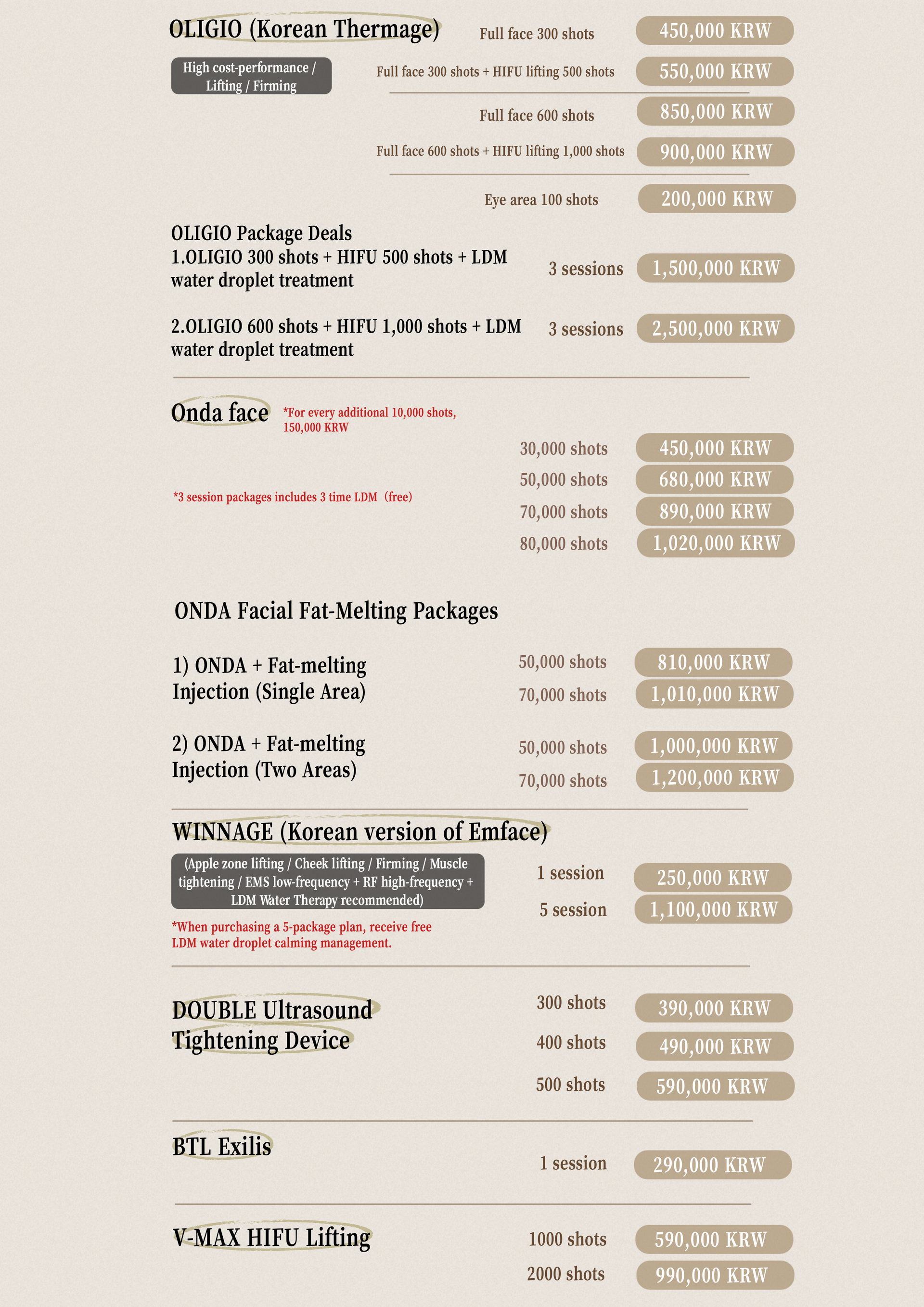
Oligio
- 100 shots: around ₩100,000–₩200,000+
- 300 shots: around ₩350,000–₩550,000+
- 600 shots: around ₩600,000–₩900,000+
- Eye Oligio: around ₩200,000–₩450,000 depending on shot count
InMode
- FX full face: around ₩70,000–₩150,000+
- Forma full face: around ₩100,000–₩200,000+
- FX + Forma: around ₩150,000–₩250,000+
- Packages may offer lower per-session pricing.
Actual prices vary considerably according to clinic, treatment area, promotions, and VAT. Some current Seoul clinics list Oligio 300 shots around ₩330,000–₩490,000 and 600 shots around ₩550,000–₩890,000, while InMode FX or Forma can be available below ₩200,000 for a single treatment.
These prices illustrate a major difference: Oligio is usually priced by shot count, while InMode is often priced by treatment mode and treatment area.
4. Which Treatment Is Better for Different Facial Concerns?
The better match depends on what you want to improve.
Oligio may be considered for:
- General facial tightening
- Mild to moderate laxity
- Reduced elasticity
- Fine lines
- Overall firmness
- Preventive anti-aging
Oligio is primarily designed around monopolar RF energy and is commonly used when improving skin firmness and elasticity is the main objective.
InMode FX may be considered for:
- Double chin
- Lower-face fullness
- Jawline definition
- Localized facial fat
- Heavier-looking cheeks
- Contouring combined with tightening
InMode FX uses vacuum-assisted RF and is commonly selected when excess tissue or fullness contributes to an undefined facial contour.
InMode Forma may be considered for:
- Mild laxity
- Skin firmness
- Fine lines
- Texture
- General RF maintenance
If your face is already relatively slim but the skin feels loose, a tightening-focused treatment such as Oligio or InMode Forma may be more appropriate than a contour-focused FX treatment.
5. What Are the Treatment Process and Recovery Like?
Both treatments are non-surgical, but the experience can differ depending on the InMode handpiece.
Oligio
A typical Oligio session involves:
- Cleansing and facial preparation
- Treatment planning
- Application of the RF handpiece
- Delivery of RF energy across the selected areas
- Cooling during treatment
- Post-treatment skincare
Oligio treatment generally takes around 15–30 minutes, depending on shot count, treatment area, and settings.
Temporary warmth, redness, swelling, or sensitivity may occur, but extended downtime is generally not required.
InMode
The process depends on the mode:
FX
- Uses suction together with RF.
- The handpiece is applied to selected areas.
- Often focuses on the jawline, cheeks, or under-chin area.
Forma
- Uses bipolar RF.
- The handpiece moves across the treatment area.
- Focuses more on skin tightening and firmness.
Some patients experience temporary redness, warmth, swelling, or bruising after InMode FX because of the suction component. The recovery experience can therefore differ from Oligio.
For foreign visitors, both can generally fit into a short Seoul itinerary, but FX may be less convenient immediately before important events if you are prone to bruising or swelling.
6. Which RF Treatment Should Foreign Patients Choose?
There is no universal winner because the two treatment approaches address somewhat different concerns.
Oligio may be a better match when:
- Skin tightening is your main goal.
- You have mild to moderate laxity.
- Your face is relatively slim.
- You want overall firmness and collagen stimulation.
- You prefer a treatment priced by RF shot count.
InMode FX may be a better match when:
- Double-chin fullness is a concern.
- You want more facial contouring.
- Your lower face has excess fat or fullness.
- Jawline definition is a major goal.
- You are comfortable with possible temporary bruising or swelling.
InMode Forma may be a better match when:
- You want a gentler RF tightening approach.
- Your main concern is skin firmness rather than fat reduction.
- You are looking for a lower-cost maintenance treatment.
For international patients, ask the clinic exactly which InMode treatment is being offered. A quote for “InMode” alone is not specific enough.
Before booking, confirm:
- Exact InMode handpiece: FX, Forma, or another model
- Number of treatment areas
- Treatment time
- Whether VAT is included
- Whether the procedure is performed by a doctor
- Expected swelling or bruising
- Recommended number of sessions
- Whether the price is promotional
Oligio also has newer versions such as Oligio X and Oligio XM, so the exact model should be confirmed when comparing treatment menus. Oligio XM combines RF and focused ultrasound technologies and should not be treated as identical to the original Oligio system.
Frequently Asked Questions
Is Oligio better than InMode for skin tightening?
Oligio is specifically designed as a monopolar RF skin-tightening platform, while InMode includes multiple technologies. Forma is more directly comparable for general tightening, while FX is more focused on contouring and localized fullness.
Is InMode cheaper than Oligio in Korea?
In many Korean clinics, InMode treatments are less expensive per session than Oligio. Current 2026 examples show Oligio 300 shots around ₩330,000–₩550,000, while InMode FX or Forma can be around ₩70,000–₩200,000 depending on the clinic and promotion.
Which is better for a double chin?
InMode FX is commonly considered when excess fat or fullness contributes to the appearance of a double chin because it combines RF with vacuum-assisted treatment. Oligio may be considered when the main issue is skin laxity rather than excess fat.
Which is better for a slim face with sagging skin?
A tightening-focused treatment such as Oligio or InMode Forma may be discussed when there is little excess facial fat. A consultation is important because excessive contour-focused treatment may not be appropriate for every slim face.
Can Oligio and InMode be done together?
Some Korean clinics offer combinations, but combining two RF treatments is not automatically necessary. The decision should depend on the treatment goals, facial anatomy, skin condition, and the specific handpieces being used.
How many Oligio or InMode sessions do I need?
The number varies according to the treatment and your goals. Oligio is often offered as a single-session tightening treatment with periodic maintenance, while InMode may be recommended as a short series when contouring is the primary goal.
Final Thoughts
Oligio and InMode are both RF-based treatments, but they are not interchangeable procedures. Oligio is primarily focused on overall RF tightening and collagen stimulation, while InMode offers different handpieces that can target either skin firmness or facial contouring.
For foreign patients visiting Korea, choose based on the problem you want to address rather than the treatment name alone. If your concern is mainly loose skin and reduced firmness, Oligio or InMode Forma may be discussed. If excess lower-face fat or a double chin is the main concern, InMode FX may be more relevant.