Juvelook vs Sculptra: Which Collagen Stimulator Is Better?
Juvelook vs Sculptra: Which Collagen Stimulator Is Better?
Juvelook and Sculptra are both injectable collagen stimulators used for gradual skin rejuvenation, but they are not the same treatment. Juvelook combines PDLLA with hyaluronic acid (HA), while Sculptra uses PLLA alone, creating differences in formulation, treatment depth, typical goals, and pricing. For foreign patients visiting Seoul, the choice depends on whether the priority is skin texture and fine lines or broader collagen loss and facial volume.
1. What Is the Difference Between Juvelook and Sculptra?
The biggest difference is the type of poly-lactic acid used and whether the product contains HA.
Juvelook
- Contains PDLLA + non-cross-linked HA.
- Commonly used for skin quality, fine lines, pores, texture, and elasticity.
- The HA component provides an additional hydration-focused element.
- Available in different concentrations, allowing treatment to be adapted to different areas.
- Often administered more superficially for skin-quality concerns.
Sculptra
- Contains PLLA (poly-L-lactic acid).
- Designed primarily for gradual collagen stimulation.
- Commonly considered when broader collagen loss and facial fullness are concerns.
- Usually planned by vial rather than by cc.
- Treatment tends to focus on deeper or broader facial areas.
Official Korean product information confirms that Juvelook uses PDLLA with HA, while Sculptra contains PLLA.
The simplest distinction is Juvelook = skin quality plus collagen stimulation, while Sculptra = broader collagen stimulation and structural rejuvenation.
2. Which One Is Better for Different Skin Concerns?
The appropriate option depends on what you want to improve.
Juvelook may be considered for:
- Enlarged-looking pores
- Fine lines
- Uneven texture
- Mild loss of elasticity
- Dull or rough skin
- Early signs of aging
- Acne-scar-related texture
- Overall skin firmness
Juvelook is often positioned as a skin-quality treatment because its PDLLA-HA formulation can be used for more diffuse concerns involving texture and fine lines.
Sculptra may be considered for:
- General collagen loss
- Loss of facial fullness
- Reduced cheek volume
- Deeper wrinkles
- Mild facial hollowing
- Declining facial firmness
- Broader age-related structural changes
Sculptra is designed to stimulate collagen progressively rather than provide the immediate volume effect of a conventional HA filler. Its official product information identifies PLLA as its main material.
If your main concern is skin texture, Juvelook may be more relevant. If your concern is broader collagen or facial volume loss, Sculptra may be considered.
3. Juvelook vs Sculptra for Different Ages
Age can provide a general reference, but it should not be the only factor used to select a collagen stimulator.
In your 20s
Juvelook may be considered for:
- Enlarged pores
- Fine lines
- Uneven texture
- Early elasticity concerns
- General skin-quality improvement
Sculptra may be less relevant when there is little structural collagen or volume loss, although individual anatomy and treatment goals still matter.
In your 30s
Both treatments may become relevant.
- Juvelook: texture, pores, fine lines, and early elasticity loss
- Sculptra: early collagen decline, firmness, and subtle facial volume changes
In your 40s
The difference may become more noticeable.
Juvelook can address skin quality, while Sculptra may be considered when collagen loss is accompanied by reduced facial fullness or structural changes.
In your 50s and beyond
Sculptra may be more relevant for broader age-related collagen and volume loss, while Juvelook can still be used to address skin texture and quality.
However, neither treatment should automatically be expected to correct significant sagging or excess skin. More advanced structural aging may require a different treatment approach.
Your skin condition, facial anatomy, and treatment goal matter more than age alone.
4. Treatment Process, Results and Downtime
Both treatments produce gradual results, but their treatment techniques can differ.
Juvelook treatment
A typical session may include:
- Consultation and facial assessment
- Cleansing and preparation
- Topical numbing
- Multiple injections into selected areas
- Cooling or soothing care
Temporary redness, swelling, tenderness, or small injection marks may occur.
The HA component can contribute to an initial hydration effect, while PDLLA supports gradual collagen stimulation. Results therefore develop progressively rather than appearing as an immediate dramatic change.
Sculptra treatment
A typical session may involve:
- Facial structure and volume assessment
- Treatment-area planning
- Cleansing and preparation
- Numbing when appropriate
- Injection of reconstituted PLLA
- Post-treatment care according to the clinic's protocol
Swelling, redness, bruising, or tenderness may temporarily occur.
Sculptra's results develop gradually as collagen forms. The final effect should therefore be assessed over weeks to months rather than immediately after treatment. The official Korean product information also emphasizes that results can vary according to the amount used, injection plane, treatment technique, and individual characteristics.
Because injection depth and placement are important, patients should choose a qualified medical professional experienced with collagen-stimulating injectables.
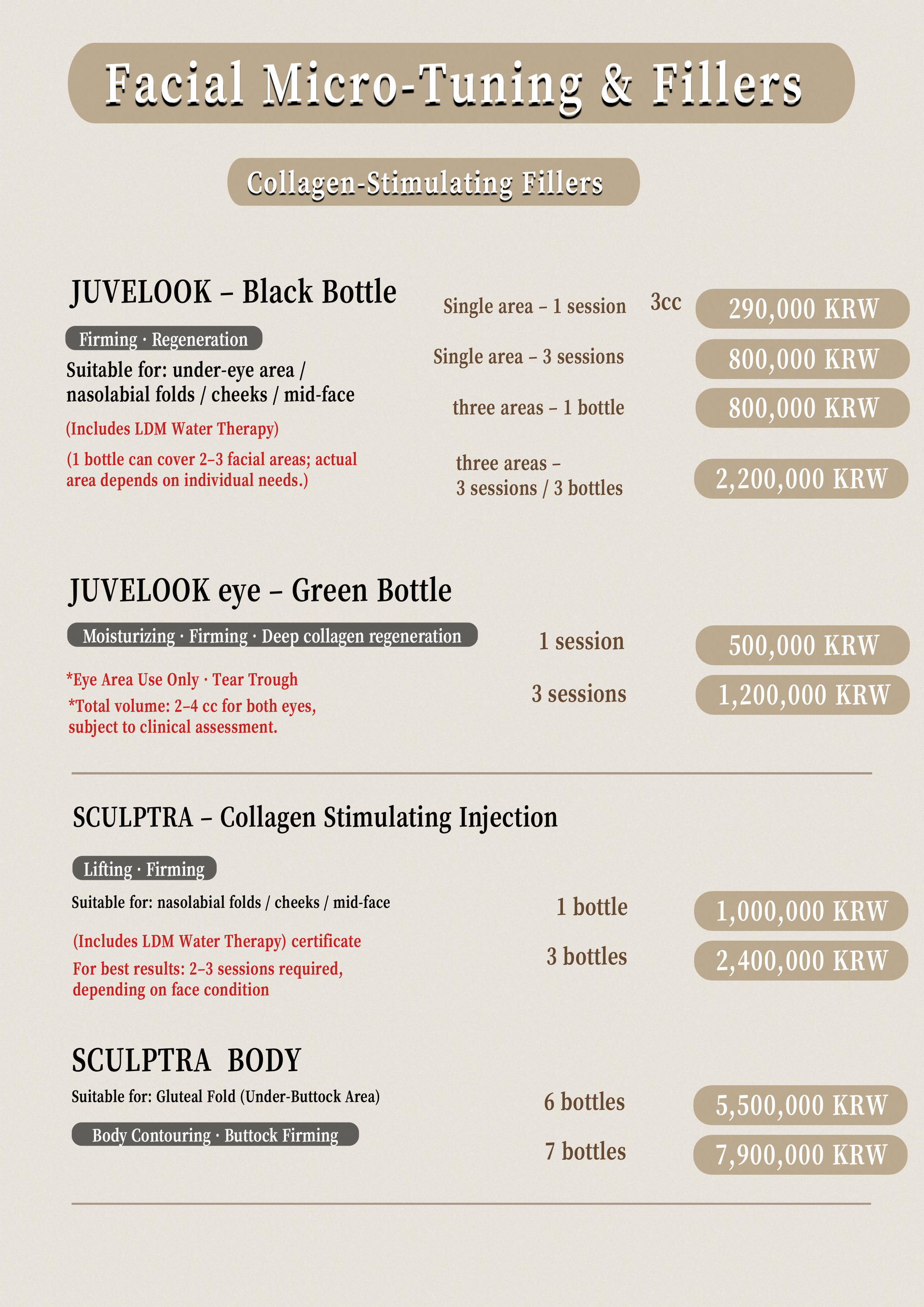
5. How Much Do Juvelook and Sculptra Cost in Korea?
Prices vary depending on the formulation, amount, treatment area, injection technique, clinic, and promotional pricing.
As a general 2026 Seoul price guide:
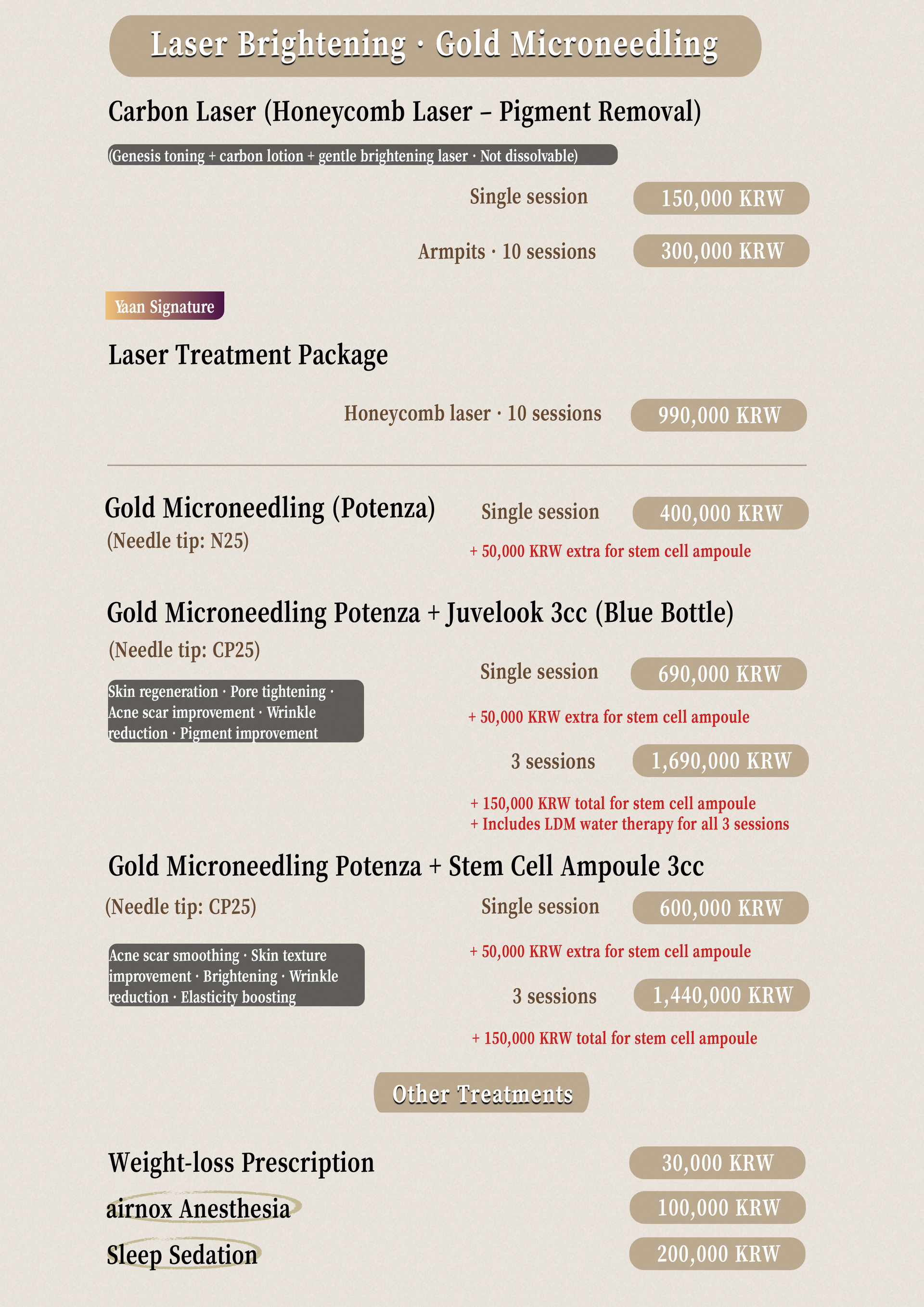
Juvelook
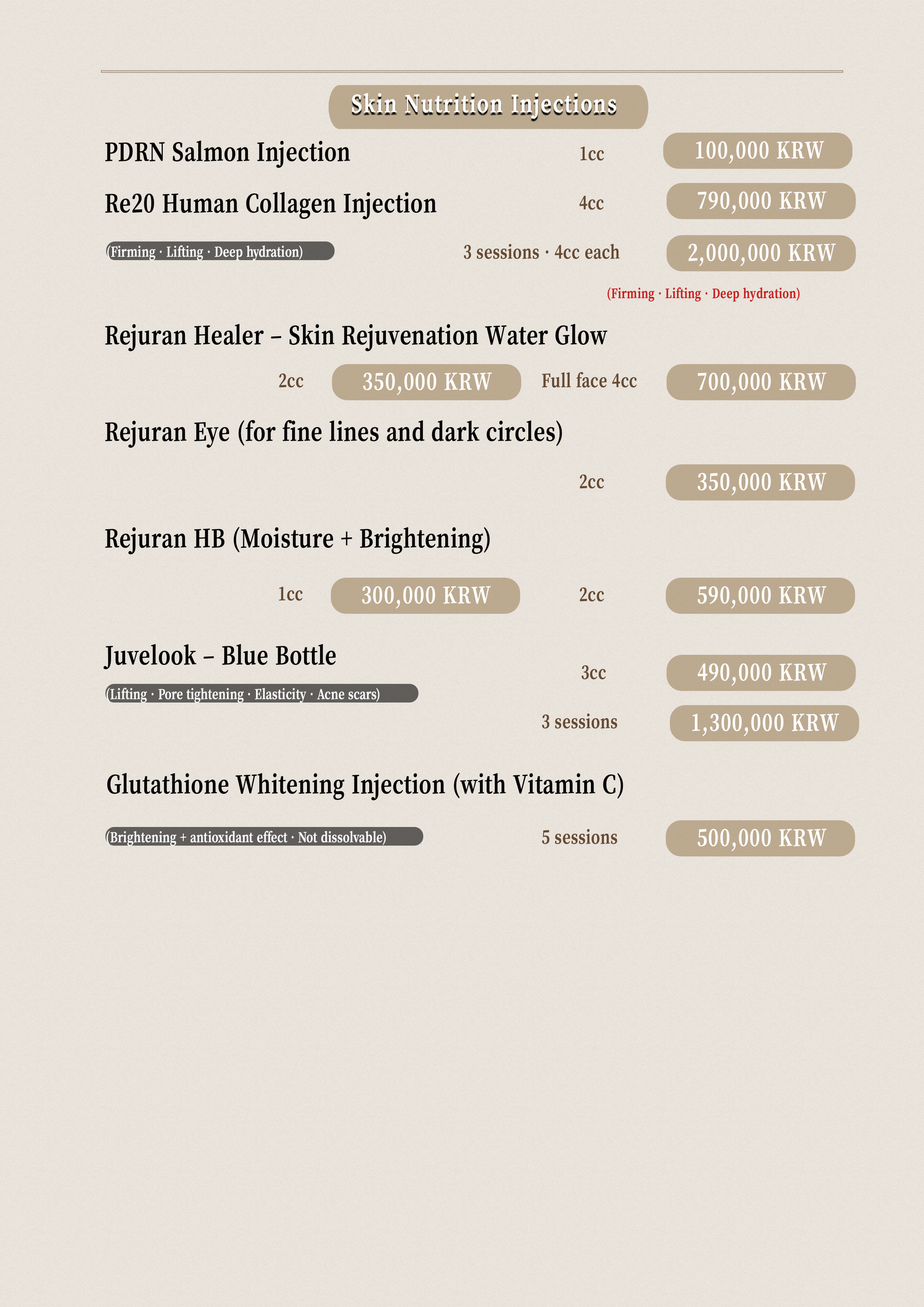
- 1–2cc: approximately ₩150,000–₩300,000
- 3–4cc: approximately ₩250,000–₩600,000
- Larger treatment plans: approximately ₩500,000–₩1,000,000+
Sculptra
- 1 vial: approximately ₩550,000–₩1,200,000
- 2 vials: approximately ₩1,000,000–₩1,800,000+
- Larger treatment plans: approximately ₩1,500,000–₩2,500,000+
Juvelook is commonly priced according to cc or formulation, while Sculptra is generally priced by vial. Korean medical literature lists Juvelook in 30, 50, 100, and 200 mg formulations, while Sculptra is listed as a 150 mg PLLA vial.
When comparing prices, foreign patients should confirm:
- Exact product and formulation
- Number of cc or vials
- Treatment area
- Injection depth and technique
- Number of planned sessions
- Whether numbing is included
- Whether VAT is included
- Whether the quoted price is promotional
A Juvelook cc and a Sculptra vial are not equivalent units, so comparing only the advertised price can give a misleading impression.
6. Which Collagen Stimulator Should Foreign Patients Choose?
The decision becomes easier when you identify the main treatment goal.
Consider Juvelook if your priorities are:
- Pore improvement
- Fine lines
- Skin texture
- Mild elasticity loss
- Skin quality
- Gradual collagen stimulation with added HA
Consider Sculptra if your priorities are:
- Broader collagen loss
- Facial fullness
- Cheek or other volume changes
- Deeper wrinkles
- Structural facial rejuvenation
- Long-term collagen stimulation
Some patients may use different treatments for different areas because the two products are not necessarily direct substitutes. Recent Korean clinical literature also emphasizes that PDLLA-based Juvelook and PLLA-based Sculptra should be considered according to their different formulations and treatment purposes rather than treated as interchangeable products.
For foreign patients visiting Seoul, ask the clinic to explain the exact formulation, dosage, injection depth, treatment area, expected timeline, recovery, and total cost before proceeding. This makes it easier to compare treatment plans accurately.
Frequently Asked Questions
Is Juvelook or Sculptra better for collagen production?
Both are designed to stimulate collagen, but they use different polymers and treatment approaches. The appropriate choice depends on the treatment area and desired result.
Is Juvelook basically the same as Sculptra?
No. Juvelook uses PDLLA with HA, while Sculptra uses PLLA. Although both belong to the broader collagen-stimulator category, their formulations and clinical use differ.
Which is better for pores and skin texture?
Juvelook is commonly considered when pores, fine lines, and uneven texture are the primary concerns.
Which is better for facial volume loss?
Sculptra may be considered when broader collagen loss and facial fullness are concerns. The appropriate treatment depends on the individual's facial structure and degree of volume loss.
Can Juvelook and Sculptra be used together?
They may potentially be incorporated into a broader treatment plan, but combining or spacing them should be determined by a qualified medical professional based on treatment areas and individual needs.
Can foreigners get Juvelook and Sculptra in Seoul?
Yes. Both are available at Korean aesthetic and dermatology clinics. International patients should confirm the exact product, dosage, treatment area, price, and aftercare instructions before treatment.
Final Thoughts
Juvelook and Sculptra are both collagen-stimulating treatments, but Juvelook is more commonly associated with skin quality, texture, and fine lines, while Sculptra focuses more broadly on collagen and facial structural changes.
For foreign patients visiting Korea, the key is to match the product to what your face and skin actually need, rather than choosing based only on popularity or price. A personalized medical consultation can determine whether skin-quality improvement, collagen stimulation, structural support, or a combination is most appropriate.