Laser Toning vs Pico Toning: What Is the Difference?
Laser Toning vs Pico Toning: What Is the Difference?
Laser Toning and Pico Toning are two popular pigmentation treatments in Korea, especially among international patients looking for brighter, more even skin. Although both are often described as “toning” treatments, they use different laser technologies. Traditional Laser Toning generally uses low-fluence Q-switched Nd:YAG laser energy, while Pico Toning uses picosecond pulses. Understanding this difference can help foreign patients compare treatment menus, prices, downtime, and expected treatment plans in Seoul.
1. What Is the Difference Between Laser Toning and Pico Toning?
The word “toning” generally describes a treatment approach rather than one specific machine. In Korean clinics, it usually refers to repeated, relatively low-intensity laser treatments designed to gradually improve pigmentation and skin tone.
Laser Toning
Traditional Laser Toning commonly uses a Q-switched Nd:YAG laser, often at 1064 nm, with low-fluence settings.
It is commonly used for:
- Melasma
- Uneven skin tone
- Mild pigmentation
- Post-acne pigmentation
- Dull-looking skin
- General complexion maintenance
Pico Toning
Pico Toning uses a picosecond laser, delivering pulses measured in trillionths of a second.
It may be used for:
- Freckles
- Sun spots
- Post-inflammatory pigmentation
- Uneven skin tone
- Stubborn pigmentation
- Overall skin brightening
The key difference is therefore not simply “old versus new.” Laser Toning and Pico Toning use different pulse durations and energy-delivery methods while pursuing a similar overall goal of improving pigmentation and skin tone.
2. How Do Laser Toning and Pico Toning Work?
Traditional Laser Toning uses repeated low-fluence laser passes to gradually target melanin. The treatment is designed to avoid aggressive disruption of the skin surface, which is one reason it is commonly incorporated into repeated pigmentation-treatment plans.
Pico Toning delivers much shorter pulses. The extremely short pulse duration can create a stronger photoacoustic effect on pigment while limiting the amount of heat delivered to surrounding tissue.
Laser Toning
- Uses nanosecond laser pulses
- Usually performed at relatively low fluence
- Gradually reduces excess pigment
- Commonly performed as a series
- Often involves minimal visible downtime
Pico Toning
- Uses picosecond laser pulses
- Delivers energy in extremely short bursts
- Can fragment pigment more efficiently
- May provide more noticeable improvement for selected pigmentation
- Can still be performed with relatively low downtime when conservative settings are used
However, pulse duration alone does not determine treatment effectiveness. Wavelength, fluence, spot size, repetition rate, and the patient's pigmentation type all influence the result.
3. Which Is Better for Melasma, Freckles and Dark Spots?
The type of pigmentation should be considered before choosing between the two.
Laser Toning may be considered for:
- Melasma
- Diffuse pigmentation
- Mild uneven skin tone
- Sensitive or reactive skin
- Long-term pigmentation maintenance
Melasma is particularly challenging because it can recur and can sometimes become worse after overly aggressive treatment. For this reason, conservative low-fluence treatment may be incorporated into some long-term melasma management plans.
Pico Toning may be considered for:
- Freckles
- Sun spots
- Localized pigmentation
- Post-acne marks
- Stubborn pigmentation
- Uneven complexion
Pico Toning can also be attractive when a patient wants to address pigmentation while pursuing additional skin-rejuvenation effects, depending on the device and treatment mode.
For international patients, it is important to understand that Pico Toning is not simply a stronger version of Laser Toning. The treatment protocol and laser settings can be completely different depending on the clinic and device.
4. Treatment Process, Downtime and Number of Sessions
Laser Toning
A typical session may include:
- Cleansing and skin assessment
- Pigmentation evaluation
- Low-fluence laser passes
- Cooling or soothing care
- Moisturizer and sun protection
Most patients experience little visible downtime. Mild redness or warmth can occur temporarily.
Because Laser Toning is generally performed gradually, patients often undergo a series of treatments rather than expecting dramatic change after one session.
Pico Toning
A typical session may include:
- Skin cleansing
- Pigmentation assessment
- Selection of wavelength and Pico mode
- Laser treatment
- Cooling or soothing care
- Sun protection
Pico Toning can also have minimal downtime when performed conservatively. Some patients may experience mild redness, warmth, dryness, or temporary darkening of pigmentation.
The number of sessions varies according to the condition:
- Mild uneven tone: May require a relatively short treatment series
- Freckles or localized spots: Treatment frequency depends on the pigment
- Melasma: Usually requires ongoing management rather than a fixed number of sessions
- Stubborn pigmentation: Multiple treatments may be needed
Neither treatment should be viewed as a guaranteed one-session solution.
5. Laser Toning vs Pico Toning Cost in Seoul in 2026
Prices vary according to the laser model, treatment area, physician, number of sessions, and whether the treatment is part of a package.
As a general 2026 Seoul guide:
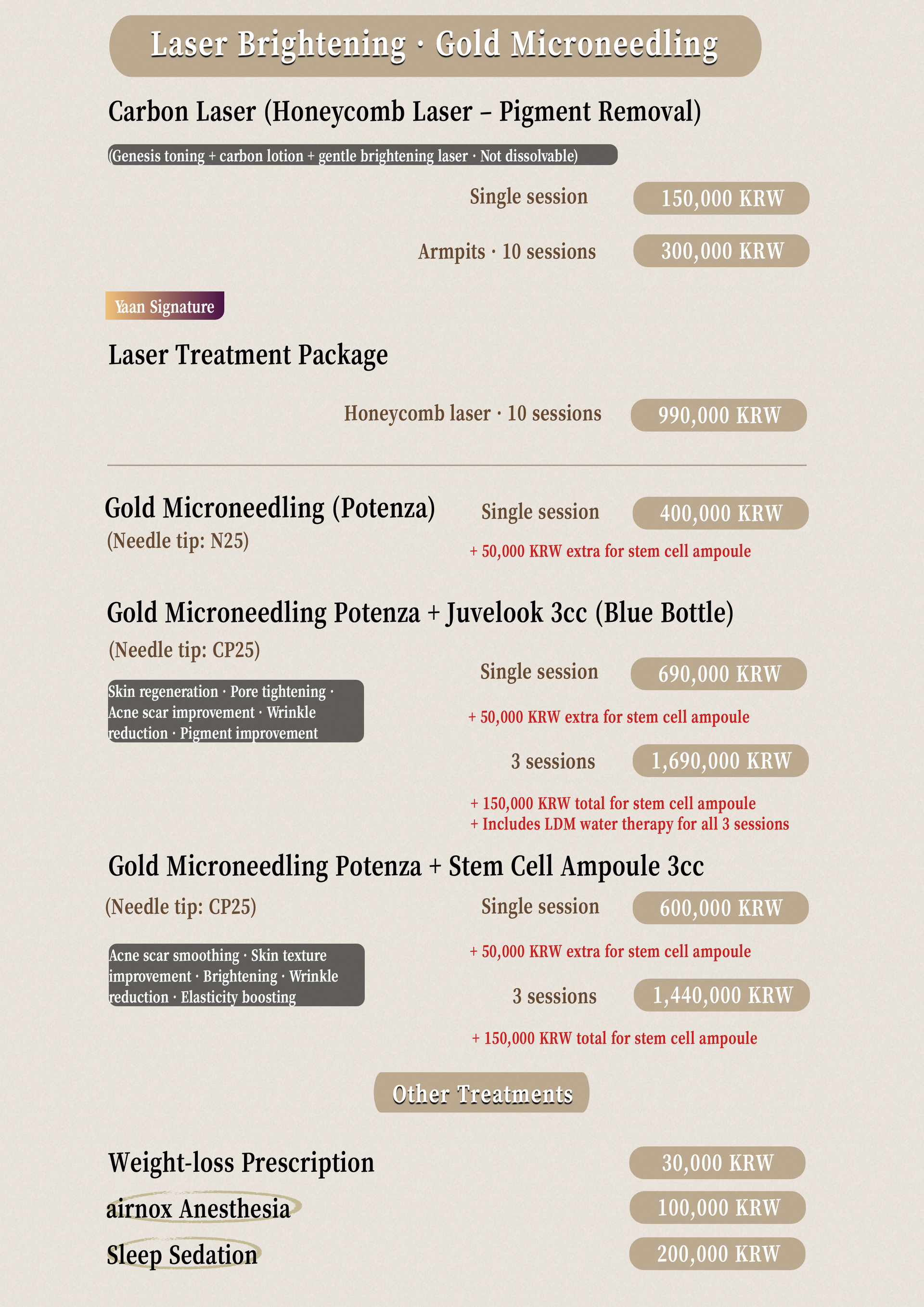
- Laser Toning: approximately ₩70,000–₩200,000 per session
- Premium Laser Toning: approximately ₩150,000–₩300,000 per session
- Pico Toning: approximately ₩100,000–₩350,000 per session
- Premium branded Pico Toning: approximately ₩200,000–₩500,000+ per session
- 5–10 session packages: approximately ₩350,000–₩1,500,000+
Actual prices can vary significantly between clinics. Published Korean clinic guides show traditional toning generally priced below Pico treatments, although promotional packages can narrow the difference.
Foreign patients should check:
- Exact laser model
- Wavelength
- Full-face or spot treatment
- Number of passes or treatment area
- Whether the treatment is truly “toning” or a more intensive Pico procedure
- Whether soothing care is included
- Whether VAT is included
- Whether the price is per session or for a package
A menu listing “Pico” does not necessarily mean that every Pico treatment is the same. Pico Toning and fractional Pico resurfacing can have very different purposes, settings, downtime, and prices.
6. Which Should Foreign Patients Choose in Korea?
There is no universal answer because Laser Toning and Pico Toning can be used for different treatment goals.
Laser Toning may be considered if:
- Melasma is your main concern
- You prefer a gradual approach
- You want minimal downtime
- You expect repeated maintenance treatments
- You have sensitive or reactive skin
- You want a lower per-session treatment cost
Pico Toning may be considered if:
- Freckles or localized dark spots are your main concern
- You want a more targeted pigment treatment
- You have stubborn pigmentation
- You are interested in additional skin-rejuvenation effects
- You prefer a newer picosecond technology
For foreign patients visiting Seoul, ask the clinic:
- Which exact laser will be used?
- What wavelength does it use?
- Is this traditional Laser Toning or Pico Toning?
- What type of pigmentation are you treating?
- How many sessions are normally recommended?
- What downtime should I expect?
- Is the price per session or a package price?
- Is VAT included?
If you have melasma, a history of post-inflammatory hyperpigmentation, or sensitive skin, the consultation is particularly important. A more advanced laser does not automatically mean a better treatment for every pigmentation problem.
Frequently Asked Questions
Is Pico Toning better than Laser Toning?
Not necessarily. Pico Toning uses shorter picosecond pulses and may offer advantages for selected pigmentation, while traditional Laser Toning provides a gradual approach that is commonly used for ongoing pigmentation management.
Is Laser Toning the same as Q-switched Nd:YAG?
Traditional Laser Toning in Korea is commonly performed using low-fluence Q-switched Nd:YAG technology, often at 1064 nm. However, the exact device and protocol can vary between clinics.
Is Pico Toning good for melasma?
It can be used in selected cases, but melasma requires careful treatment because aggressive laser settings may aggravate pigmentation. The appropriate wavelength and energy level should be determined based on the patient's skin and diagnosis.
Does Pico Toning have more downtime?
Not necessarily. Conservative Pico Toning can involve minimal downtime, although mild redness, warmth, dryness, or temporary darkening may occur. More intensive Pico treatments can involve more visible recovery.
How many Laser Toning sessions do I need?
Laser Toning is generally performed as a series of treatments. The number varies according to pigmentation, skin response, and treatment goals rather than following one fixed schedule.
Can I combine Laser Toning and Pico Toning?
Some clinics may use different laser approaches during a broader pigmentation treatment plan, but combining or alternating treatments should be based on the diagnosis, skin response, and treatment settings rather than simply using both for stronger results.
Final Thoughts
Laser Toning and Pico Toning share the goal of improving pigmentation, but they use different laser technologies and treatment strategies. Traditional Laser Toning generally emphasizes gradual, low-fluence pigment management, while Pico Toning uses ultra-short picosecond pulses for more targeted pigment fragmentation.
For foreign patients in Korea, the most important factors are the type of pigmentation, laser wavelength, treatment settings, skin sensitivity, downtime, and overall treatment plan. Comparing the exact device and protocol is more useful than choosing based only on the words “Laser Toning” or “Pico Toning.”